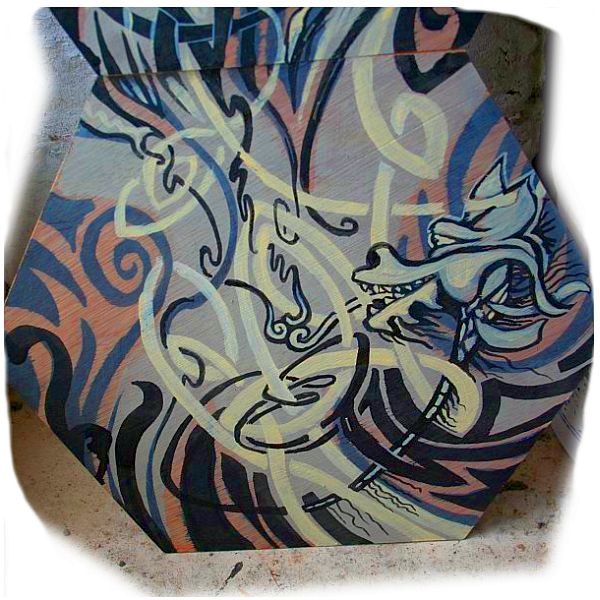
In this winter's quieter moments, there's the chance to draw. It's a great excuse to just gaze as well, and just to wonder at how the material world is as it is. The more I gaze, the more I wonder,and the more I wonder the more I wander - into the realm of fantasy and fable. Below is part of a longer panel around the idea of the Celtic tree-spirit, Leannan si. I'm playing with ideas such as these at Celtashgill, my new Wondercelt blog.
Running water, cold air and rocks collaborate and create fantastic forms of ice, turning unremarkable gills into remarkable wonderlands.
Ice grows its crystals across glass, along twigs and around the edges of foliage, leaving another lexicon of shapes from which to draw.
the wild studio experience - in the early spring of 2010, I made a shelter for observing, drawing and making artwork, high up on the fellside behind my North Pennines home in England's north. Since that time I've tried exploring other landscapes with a similar immersion in their environments. This (b)log describes my progress and some other works.
Showing posts with label nature/culture. Show all posts
Tuesday, 7 February 2012
shape-shifting
Labels:
drawing,
myths,
natural forces,
nature/culture,
trees,
visual art,
water
Friday, 15 July 2011
still learning
Although two seasons have passed since my shelter was dismantled, the experience continues to inform my work. The tumbling of the sky over the land, the scouring by rainwater, and the exposure of rock and buried peat all contribute to the way the composition forms itself.
It's haymaking time just now, and the patterns of the hay meadows are accentuated as the hay is cut, dried, turned and bailed. The sun early in the morning and late in the evening floods over the fellsides, picking out the drama and tensions between the wild gills, the tamed meadows and the drystone walls that separate them.
Labels:
natural forces,
nature/culture,
North Pennines,
seasons,
visual art
Sunday, 22 May 2011
drawing threads
A visit to the Tarset valley in Northumberland on Thursday placed me in a different landscape and stimulated some new drawing. However, within seconds of laying out my materials, my attention was drawn to the ground around my feet, where fresh wood sorrel (oxalis) was growing through the leaf litter and moss. I became engrossed in the same old topic of the adaptive cycle, and the same old obsession with triadic form and composition. Sorrel, moss, and leaf litter were representing the stages of development, consolidation and release. The leaves of the sorrel were divided into three.
After the sorrel, I turned my attention to a dead tree that had fallen across a drystone wall. Here again was the same adaptive cycle. The dead tree had created a new and vibrant environment for insects and therefore a food source for birds. The wall had lost its original purpose of creating a boundary; it was keeping nothing out or keeping nothing in. It had been colonised by plants, some seeking shade, some seeking dry rooting and others seeking shelter from wind.
Light gives way to dark, dark to light, death to life, life to death. Everty time I draw I explore and excite new relationships.
By drawing the rotting wood, the rusting iron and the crumbling stone of the farm buildings at Tarset, I understood a little more about the buildings' history, and how it was connected to the changing practice of agriculture from pre- to post-industrial times. The farm buildings are now used for more than stock and crops. There is a studio for artists who stay for a year's residency and an office for the publishers of poetry. A barn is used for exhibitions. So the cultural space, too, has adapted to change.
As I was drawing, I reflected on what I was doing. This was my way of experiencing 'deep ecology'. I continue to struggle with the question - is this the way I see things, or is this the way things really appear? I feel part of,and apart from, this place and its inhabitants at the same time.
After the sorrel, I turned my attention to a dead tree that had fallen across a drystone wall. Here again was the same adaptive cycle. The dead tree had created a new and vibrant environment for insects and therefore a food source for birds. The wall had lost its original purpose of creating a boundary; it was keeping nothing out or keeping nothing in. It had been colonised by plants, some seeking shade, some seeking dry rooting and others seeking shelter from wind.
Light gives way to dark, dark to light, death to life, life to death. Everty time I draw I explore and excite new relationships.
By drawing the rotting wood, the rusting iron and the crumbling stone of the farm buildings at Tarset, I understood a little more about the buildings' history, and how it was connected to the changing practice of agriculture from pre- to post-industrial times. The farm buildings are now used for more than stock and crops. There is a studio for artists who stay for a year's residency and an office for the publishers of poetry. A barn is used for exhibitions. So the cultural space, too, has adapted to change.
As I was drawing, I reflected on what I was doing. This was my way of experiencing 'deep ecology'. I continue to struggle with the question - is this the way I see things, or is this the way things really appear? I feel part of,and apart from, this place and its inhabitants at the same time.
Monday, 3 January 2011
frozen out
![]() |
| snow remnants |
![]() |
| Dragonade: Rolling Minstrels |
In the next three months I shall use the images and material that I've harvested from the site over the year to create, assemble and curate an exposition for display and/or publication.
![]() |
| Supine Earth; Rolling Minstrels |
Labels:
earth,
human relationships,
myths,
nature/culture,
reflection,
seasons,
visual art
Tuesday, 22 June 2010
summer solstice
The sun climbed high enough to breach the ridge of the hill and cast its rays on the shelter at about 7.30am, peeking through a gap in the apex.
Today I stopped on the way and considered building a platform in a beech tree much further down the hillside. The beech had fallen down, probably 20 years' ago, but had continued to grow, forming a covered space at its base. It was a tempting diversion, as ever, but I managed to stay focussed and collected more material to blend-in the shelter. I've made a threshold out of a chewed-up piece of spruce. I keep adding 'thresh' to the floor of the shelter, but it's as wet as ever. I'm beginning to think that only a massive amount of woodchips will do.
I've made a spindle out of scrap wood and tried spinning different sheep-fleeces. Bluefaced-Leicester wins hands-down, but the black-faced rough fell sheep from Clare Island come in second at the moment, with the Swaledale as the least favourable. I've used some of the lengths of yarn to tie-in some of the woven struts in the shelter.
Cross Fell's summit was a turmoil of cloud in an otherwise blue sky this morning, so I did a drawing of it from above the shelter. When I looked back at the shelter I realised I was looking at a margin of the nature/culture interface in sharp relief because of the long early morning shadows. I did a drawing of this.
Because I had built the shelter, I knew its structure well, so it was an easy and satisfying drawing to make. I'm going back as soon as I can with paint. I think that after three years of talking about this nature/culture interface, I've finally found it...
...so, I took up a canvas, paints and brushes (along with a storm kettle for a brew) in the late afternoon. For various reasons it took me an age to get settled and start. For one thing, I hadn't been up there at this time of day before in the strong sun, so I was surprised how obvious the shelter looked. The wet floor inside means not being able to put anything down on it, and I'm still short of raised resting places. I seemed to spend my time picking items up and setting them down again, swapping places like a slow motion game of musical chairs. It got more ridiculous. I took the canvas, paints & brushes up the slope to look down on the shelter. I was immediately attacked by a wide range of insects from ants to midges, even though the wind was strong enough to blow the canvas off its perch. The longer I sat on the soft heather, the more I became aware of a massing army of insects prepared to defend their homelands from attack. I reckoned that if I softened and thinned the paint with turpentine, I could work quickly with some semblance of control. However, the turps I'd put in a screwtop jar had all but evaporated. I gave up trying to paint in a conventional manner and just clagged paint over the canvas and beat the retreat. A piece of shale seemed to have more structure and interest than my painting.
Today I stopped on the way and considered building a platform in a beech tree much further down the hillside. The beech had fallen down, probably 20 years' ago, but had continued to grow, forming a covered space at its base. It was a tempting diversion, as ever, but I managed to stay focussed and collected more material to blend-in the shelter. I've made a threshold out of a chewed-up piece of spruce. I keep adding 'thresh' to the floor of the shelter, but it's as wet as ever. I'm beginning to think that only a massive amount of woodchips will do.
I've made a spindle out of scrap wood and tried spinning different sheep-fleeces. Bluefaced-Leicester wins hands-down, but the black-faced rough fell sheep from Clare Island come in second at the moment, with the Swaledale as the least favourable. I've used some of the lengths of yarn to tie-in some of the woven struts in the shelter.
Cross Fell's summit was a turmoil of cloud in an otherwise blue sky this morning, so I did a drawing of it from above the shelter. When I looked back at the shelter I realised I was looking at a margin of the nature/culture interface in sharp relief because of the long early morning shadows. I did a drawing of this.
Because I had built the shelter, I knew its structure well, so it was an easy and satisfying drawing to make. I'm going back as soon as I can with paint. I think that after three years of talking about this nature/culture interface, I've finally found it...
...so, I took up a canvas, paints and brushes (along with a storm kettle for a brew) in the late afternoon. For various reasons it took me an age to get settled and start. For one thing, I hadn't been up there at this time of day before in the strong sun, so I was surprised how obvious the shelter looked. The wet floor inside means not being able to put anything down on it, and I'm still short of raised resting places. I seemed to spend my time picking items up and setting them down again, swapping places like a slow motion game of musical chairs. It got more ridiculous. I took the canvas, paints & brushes up the slope to look down on the shelter. I was immediately attacked by a wide range of insects from ants to midges, even though the wind was strong enough to blow the canvas off its perch. The longer I sat on the soft heather, the more I became aware of a massing army of insects prepared to defend their homelands from attack. I reckoned that if I softened and thinned the paint with turpentine, I could work quickly with some semblance of control. However, the turps I'd put in a screwtop jar had all but evaporated. I gave up trying to paint in a conventional manner and just clagged paint over the canvas and beat the retreat. A piece of shale seemed to have more structure and interest than my painting.
Subscribe to:
Posts (Atom)